Shepherd’s Harvest Festival May 15 – 17

This coming weekend is one of Minnesota’s big events for fiber folks. It’s held at the Washington County fair grounds in Lake Elmo, an eastern suburb of St. Paul. In addition to lots of classes on everything from fiber animal care to dying fiber for special effects, there is a LARGE assortment of vendors with their wares.

I will be selling my Babydoll and Shetland fiber at the Natural Fiber Alliance booth. It will be in all conditions from fleeces “in the grease” to spun yarn and batts. My first lot of processed wool will be back from Dakota Fiber Mill, so there are even more colors to choose from – think coated black lamb!!! Another new item is rovings made from a Babydoll/alpaca blend. Scrumptuous!

http://shepherdsharvestfestival.org/

A sampling of the fiber that will be for sale next weekend (or any day on-line). It does not include items yet from this year's shearing, like super black lamb and a wool/alpaca blend.

A sampling of the fiber that will be for sale next weekend (or any day on-line). It does not include items yet from this year’s shearing, like super black lamb and a wool/alpaca blend.


Organic Matter and Plant Nutrients

This year I am applying a serious amount of organic matter to the vegetable garden and a new hazelnut growing field. My source is a dairyfarm over in Wisconsin that markets their composted dairy manure as Cowsmos. I have two 1500-pound totes of straight dairy manure compost and two totes of this mixed with biochar – a more persistant form of organic matter used as a soil ammendment.  I had help from a dear friend this week to get the material applied for use in vegetable production for my produce CSA and also to benefit the hazelnut planting going in next month.  The latter was carefully set up to help determine the relative benefit of biochar vs. simple compost. This will be a long term evaluation.

Making use of used feed bags to make paths among beds to be topped with composts.

Making use of used feed bags to make paths among beds to be topped with composts.

Transferring the moist compost to the front loader for transport to the garden.

Transferring the moist compost to the front loader for transport to the garden.

Five-gallon buckets full of biochar/manure mix (darker - to left) and simple manure compost (lighter brown  - to right) in area worked up for hazel planting.

Five-gallon buckets full of biochar/manure mix (darker – to left) and simple manure compost (lighter brown – to right) in area worked up for hazel planting.

Veggie Action

The season has begun for growing food! This post will telescope a few weeks’ worth of activities. I’ve been starting batches of seeds in the basement and my bedroom window over bottom heat.


Direct-seeded snap pea in the raised bed.

Direct-seeded snap pea in the raised bed.

A few of the earliest - kohl crops and parsley for transplanting into raised bed.

A few of the earliest – kohl crops and parsley for transplanting into raised bed.

A variety of tomatoes being grown for potential farmers' market sales.

Varieties of tomatoes being grown for potential farmers’ market sales.


A number of the batches are ready and have been transplanted to their respective grow-out locations in the greenhouse.  It feels good to get the seedlings launched to their ultimate sites so I can get the next batch started using the same heat mats and trays.

A pepper plant in the aquaponic syphon bed.

A pepper plant in the aquaponic syphon bed.

The aquaponic raft bed with the new LED lighting.

The aquaponic raft bed with the new LED lighting.

P15-0489e plant in raised bed

Kale now with roots in the raised bed.


I have three families I am serving with a fresh produce CSA (consumer supported agriculture) this summer. Scheduling harvest dates – not just “whenever” is a new challenge to the greenhouse and outdoor garden venture this year.

A Song for Annika

Baby Annika, Baby Annika, will you come play with me?
Baby Annika, Baby Annika, we’ll be happy and free.
We will jump and play. We will jump and play, then we’ll lay in the sun.
We will jump and play, then we’ll eat some hay when the whole day is done.

2015 Lambing (Updated 4/9/15)

Hattie and Fergie were just a couple days early delivering their respective sets of twins.  Hattie produced Abner and Abigail around 10:00a.m. Tuesday the 24th.  Fergie had problems with her first lamb, Adrien, who came out nose first and no legs.  She powered through, however, and Adam popped out within a minute or so around 2:00 a.m. Wednesday, March 25th.  They’re all frisky and already decked out in ear tags and tail bands.  I’m glad they were early, because the lambing jugs have been kept busy with the first-timers, who were supposed to be about a week later (https://prairieplumfarm.com/2015/03/28/sad-story-big-boys-in-little-ewes/).  Nina gave birth to little Alyssa on Friday morning, March 27th.

Hattie with Abner and Abigail at 1 day.

Hattie with Abner and Abigail at 1 day.

Fergie with Adrien and Adam at .5 day.

Fergie with Adrien and Adam at .5 day.

Nina with Alyssa just learning to suckle (< 1 hr old).

Nina with Alyssa just learning to suckle (< 1 hr old).


The tide has turned to the off-white colored lambs. On Monday evening, March 30th, Claire gave birth to Amos, a whopping 9 pound ram. Within an hour Iris produced a set of twins, Andy and Annika. True to the vet’s prognostication, Iris didn’t produce milk, so I’m caring for the spunky twins for now. They are well traveled, having accompanied me to work and my uncle’s funeral. Penny broke the “bad news” streak and was the first yearling ewe to have a live birth delivering April Saturday morning, April 4th. Her twin sister, Paula, reportedly lambed successfully earlier in the week at her new home.  

All lambs except April are available for sale. Alyssa has already been reserved by a new family. Andy will be wethered and is one friendly little dude for companionship, mowing, and fiber.


Amos at 4 days.

Amos at 4 days.

Andy and Annika basking in sun while I work.

Andy and Annika basking in sun while I work.


Audrey is the latest addition to the flock and last lamb of the season. She was born to Rhonda (and Winslow) Saturday, April 11th.  She’s doing great but looks miniature next to the twins born 18 days earlier.


Newborn April in warm-up jacket.

Newborn April in warm-up jacket.

Shearing Day 2015

Saturday, March 21st, was a beautiful sunny day and a fine day for shearing the flock.  The work crew assembled for lunch prior to the activity and final set-up for the maturnity pens was completed.  We had a crew of six plus the shearer himself.  One person fetched the sheep, one shut opened and shut the gate, one flipped the sheep on their rump, one scooped up the fleece, one folded and bagged the fleece, and the final one swept up the belly wool between animals.  It was quite the circus.  I was the one fetching the sheep, which also entailed removing and, when time permitted, replacing coats on the yearling ewes.  The fleeces look wonderful and I’m hoping for some time between Lamb Watches to get some skirting done. Preliminary weights of unskirted greasy fleece are: 35 pounds off-white Babydoll, 31 pounds colored Babydoll, 2.5 pounds silver Shetland and 2.75 pounds black Shetland.

Fred with Noir on deck for shearing.

Fred with Noir on deck for shearing.

Mature ewes awaiting shearing.

Mature ewes awaiting shearing.

Sara with newly completed runs for expectant ewes and new families.

Sara with newly completed runs for expectant ewes and new families.

The harvesting of J.C.'s megafleece.

The harvesting of J.C.’s megafleece.

The newly shorn yearling ewes with coats reapplied.

The newly shorn yearling ewes with coats reapplied.

Yours Truly with bags of fleece hung for drying in the greenhouse.

Yours Truly with bags of fleece hung for drying in the greenhouse.


Sad Story – Big Boys in Little Ewes

The last few days have not been the best for lambing. . . 3 still-born ram lambs.  Two of these were from the ewes (Sara and Rachel) I had tried to prevent from breeding last fall due to their small size. The third was from my dear Olivia, who was the largest of last year’s lambs. But when the rear instead of front legs – plural, is presented with the nose, all is not going to go through the birth canal properly. Rachel’s had NO legs presented.  I wasn’t around for the birth of Sara’s ram so don’t know the circumstances.  The good news is the ewes appear to be fine – though I’m watching them closely. My vet had an interesting insight – she said in about 90% of difficult births she has assisted with – whether it be goats, cattle, or sheep – the infant is a male.

Babydoll batts now available

Yesterday I picked up the first batts made from the wool of my Babydoll Southdown sheep from the fiber mill. They are wonderfully lofty! Each weighs approximately 12 ounces and measures 24″ x 36″ x 3″. Because of the layering manner in which they are made, they can be easily split to half that thickness (1.5″), if desired. I’m planning on playing with one myself – not sure if I’ll make a vest or a lap robe insert first. The rest are available for purchase at $18 each.  I have 5 off-white and 2 dark brown. 

P15-0269e individual batt 24 x 36 P15-0270e batt closeup P15-0272e 6 batts

Garden Planning

P15-0248e resourcesThe planning for this summer’s plantings is well under way. Orders for plants and seeds have been sent. New for this season will be a planting of 180 hybrid hazels and a collection of small fruits: currants, gooseberries, and bush cherries. The hazel planting will include an trial of the effects of biochar as a soil ammendment in the establishment of perennial crops. I’m also working at devising ways to safely enable sheep grazing among the hazels. Due to the large number of plants involved, the per unit cost needs to be kept low.  Continuing education is… continuing.  I’ll be attending full day class at the Midwest Organic and Sustainable Education Service (MOSES) conference this Thursday on value-added options for fruit growers.  I may add vinegars to my offerings of preserves this year. 

2014 Fleeces

I will be offering individual raw fleeces for sale from this spring’s clip. Shortly after shearing I will post weights to the web page along with close-up photos of the surface of each fleece and samples of individual locks/staples.  The coated fleeces will be skirted to sell just the area covered by the coats.  Unfortunately, due to my inexperience at this, I will not be able to set a per pound price until I see the quality (cleanliness, color, and staple length) of each fleece.  I expect the prices to range from $16/pound for adult off-white fleece (averaged 5.75# per ewe last year; 8# for Edwin and J.C.) to $22/pound for coated black lambs. I’m guessing about 4# each after considering 25% not covered.  *This year the adult fleeces will have 2 weeks’ less growth than last – 52 vs. 54 weeks. 

If you care to reserve the “right of first refusal” for any, please let me know.  I am reserving Rachel’s fleece for personal use.

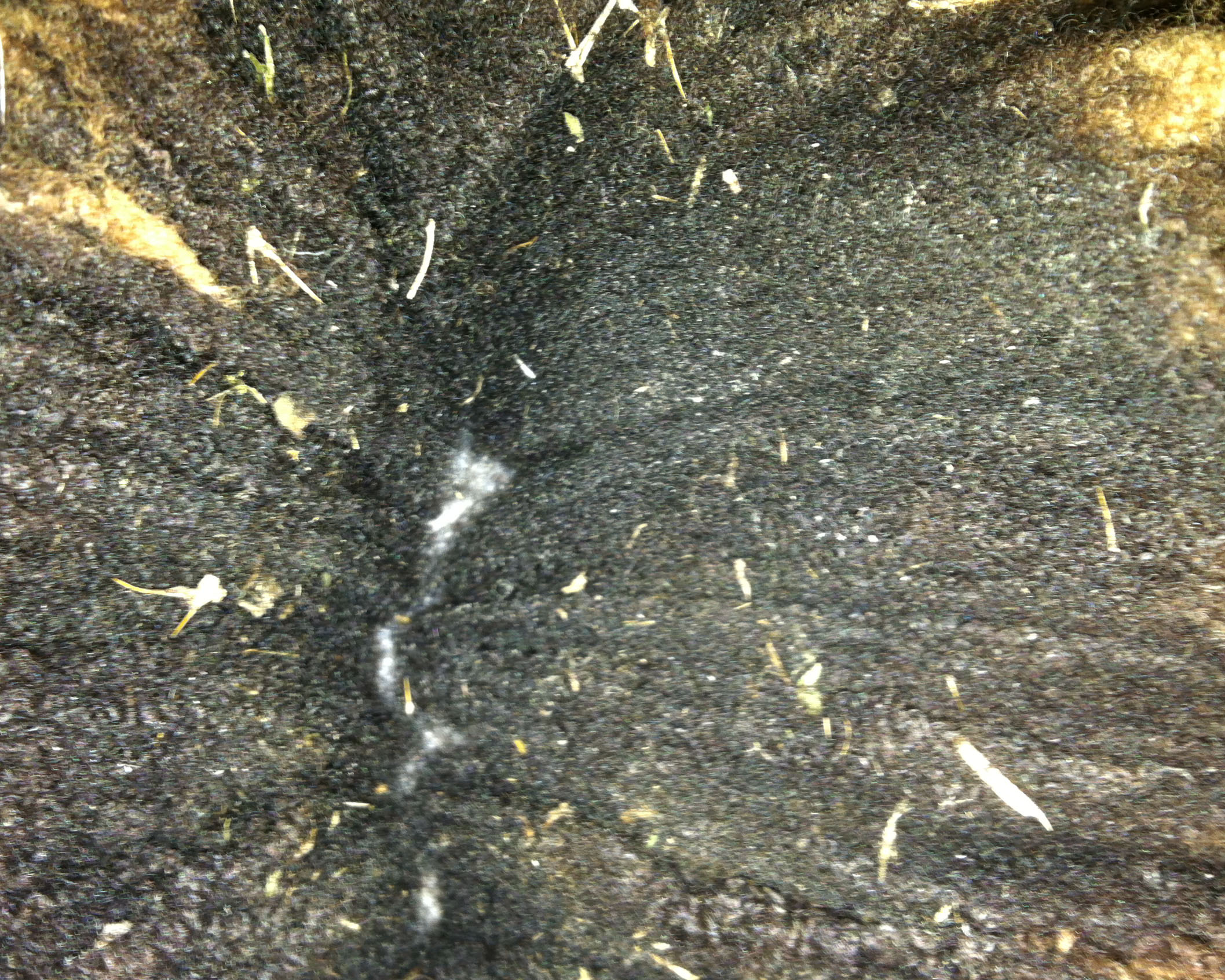
Here are some close-up photos I took last week of some of the adult black sheeps’ coats as a preview.

P15-0173c Fergie's wool


Fergie (Babydoll ewe) 

Butterscotch on surface, dark charcoal at skin

2014 clip stats: produced 6# raw fleece, 62% > 2″


P15-0174c Hattie's wool


Hattie (Babydoll ewe)

Fading faster than Fergie although same age. 

2014 clip stats: produced 5.4# raw fleece, 54% > 2″, taupe, soft!


P15-0176c J.C. wool
J. C. (Babydoll ram)

Still dark at the skin! 2014 color of main fleece = dark walnut (britch and gray portions, especially from head processed separately)

2014 clip stats: produced 8# raw fleece, 77% > 2″


P15-0178c Noir wool


 Noir (Shetland wether)

Black at skin, warm chocoate brown at tips.  Full year’s coat

Expect serious vegetative matter – will be priced accordingly.

No 2014 data and he’s a little dude.


P15-0177c Moonshadow wool


Moonshadow (Shetland wether)

Will be 6 months of growth – clean in spite of his shunning a coat


Examples of what to expect for the yearling ewes:

Nina’s 2014 clip stats: produced 5# raw fleece, but 84% of it was > 2″ to yield more skirted fleece weight than any of the adult ewes.  They don’t come out of the womb naked, they’ve been growing their wool for some time already.

Katie’s 2014 clip stats; produced 5.75# raw fleece, 65% > 2″.  Caviot… both of these girls were 53 weeks old when shorn for the first time.  This year’s crop of lambs will be 51 to 45 weeks old, if I get the shearing date I’m aiming for (1 week before Hattie and Fergie are due to lamb).